Linear advection equation with variable coefficients
This tutorial is concerned with the linear advection equation
\[\begin{aligned} \partial_t u(t,x) + \partial_x (a(x) u(t,x)) &= 0, && t \in (0,T), x \in (x_{min}, x_{max}), \\ u(0,x) &= u_0(x), && x \in (x_{min}, x_{max}), \\ \text{boundary conditions}, &&& x \in \partial (x_{min}, x_{max}) \end{aligned}\]
with variable coefficient $a$.
The boundary conditions depend on the sign of the transport velocity $a$ at the boundary. In particular, specifying a Dirichlet type boundary condition is only allowed for inflow boundaries, e.g. $a(x_{min}) > 0$ at $x = x_{min}$.
SummationByPartsOperators.jl includes a pre-built semidiscretization of this equation: VariableLinearAdvectionNonperiodicSemidiscretization. Have a look at the source code if you want to dig deeper. Below is an example demonstrating how to use this semidiscretization.
using SummationByPartsOperators, OrdinaryDiffEqSSPRKusing LaTeXStrings; using Plots: Plots, plot, plot!, savefig# general parametersxmin = -1.xmax = +1.tspan = (0., 8.0)afunc(x) = one(x)u0func(x) = sinpi(x)# Dirichlet type boundary conditions; they are used only at inflow boundariesleft_bc(t) = t >= 3 ? sinpi(t) : zero(t)right_bc(t) = zero(t)# discretization parametersinterior_order = 4N = 101# whether a split form should be applied or notsplit_form = Val(false)# setup spatial semidiscretizationD = derivative_operator(MattssonSvärdShoeybi2008(), 1, interior_order, xmin, xmax, N)# whether or not artificial dissipation should be applied: nothing, dissipation_operator(D)Di = nothingsemi = VariableLinearAdvectionNonperiodicSemidiscretization(D, Di, afunc, split_form, left_bc, right_bc)ode = semidiscretize(u0func, semi, tspan)# solve ODEsol = solve(ode, SSPRK104(), dt=D.Δx, adaptive=false, save_everystep=false)# visualise the resultplot(xguide=L"x", yguide=L"u")plot!(evaluate_coefficients(sol.u[1], semi), label=L"u_0")plot!(evaluate_coefficients(sol.u[end], semi), label=L"u_\mathrm{numerical}")savefig("example_linear_advection.png");"/home/runner/work/SummationByPartsOperators.jl/SummationByPartsOperators.jl/docs/build/tutorials/example_linear_advection.png"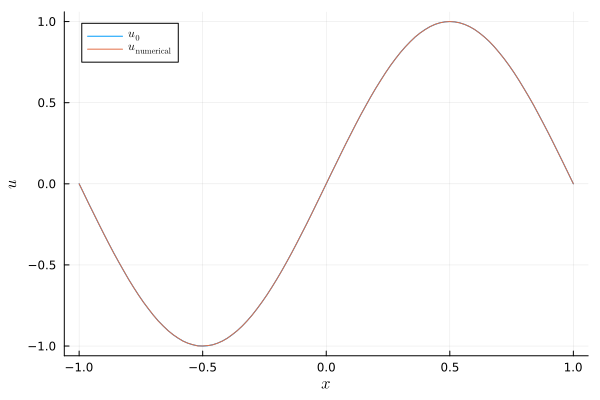
Package versions
These results were obtained using the following versions.
using InteractiveUtilsversioninfo()using PkgPkg.status(["SummationByPartsOperators", "OrdinaryDiffEqSSPRK"], mode=PKGMODE_MANIFEST)Julia Version 1.10.12
Commit d93beab124c (2026-08-15 10:29 UTC)
Build Info:
Official https://julialang.org/ release
Platform Info:
OS: Linux (x86_64-linux-gnu)
CPU: 4 × AMD EPYC 7763 64-Core Processor
WORD_SIZE: 64
LIBM: libopenlibm
LLVM: libLLVM-15.0.7 (ORCJIT, znver3)
Threads: 2 default, 0 interactive, 1 GC (on 4 virtual cores)
Environment:
JULIA_PKG_SERVER_REGISTRY_PREFERENCE = eager
Status `~/work/SummationByPartsOperators.jl/SummationByPartsOperators.jl/docs/Manifest.toml`
[669c94d9] OrdinaryDiffEqSSPRK v2.3.2
[9f78cca6] SummationByPartsOperators v0.5.103 `~/work/SummationByPartsOperators.jl/SummationByPartsOperators.jl`